Turing Test, a concept birthed from the brilliant mind of Alan Turing, continues to stir conversations about artificial intelligence today. It serves as a benchmark for determining whether machines can exhibit human-like intelligence, provoking both fascination and debate in the realms of technology and philosophy.
The Turing Test not only reflects the historical significance of AI’s evolution but also encapsulates the intricate relationship between consciousness and machine capabilities. From its origins amidst the early days of computing to its influence on modern chatbots, this test raises essential questions about what it truly means to think and feel.
The historical context of the Turing Test and its significance in artificial intelligence

The Turing Test, proposed by British mathematician and logician Alan Turing in 1950, serves as a pivotal foundation for the field of artificial intelligence (AI). Turing’s work not only sparked fundamental discussions about the capabilities of machines to exhibit intelligent behavior but also laid the groundwork for ongoing debates regarding the nature of consciousness and the potential of machines to think. His original paper, “Computing Machinery and Intelligence,” was a groundbreaking exploration of these concepts during a time when computer technology was still in its infancy.
Turing proposed the test in a cultural milieu marked by rapid technological advancements and the aftermath of World War II. The 1950s were characterized by the burgeoning of electronic computing and the exploration of machine capabilities. Turing, envisioning a future where machines could potentially simulate human conversation convincingly, introduced a simple yet profound concept: if a machine could engage in a conversation indistinguishable from a human, it could be said to “think.” This idea reflected both the optimism surrounding technology and the philosophical inquiries into what it means to possess intelligence.
Early artificial intelligence systems inspired by the Turing Test
Numerous early AI systems were influenced by the principles of the Turing Test, aiming to emulate human-like conversation and reasoning. These systems served not only as practical applications of Turing’s hypothesis but also as experimental platforms for testing the boundaries of machine intelligence.
One of the earliest examples is ELIZA, developed by Joseph Weizenbaum in the mid-1960s. ELIZA simulated a psychotherapist by using pattern matching and substitution methodology to engage users in conversation. This program was a remarkable demonstration of how a computer could mislead users into believing they were conversing with a human, embodying the essence of the Turing Test.
Another notable instance is the SHRDLU program created by Terry Winograd in 1970. SHRDLU was capable of understanding and manipulating blocks in a virtual environment using natural language input. It showcased the potential for machines to not only respond appropriately to queries but also to comprehend context and follow instructions, further pushing the boundaries of AI as envisioned by Turing.
The development of these systems reflects a significant leap in technology and understanding of AI, making strides toward the ambitious goals set forth by Turing. These early endeavors underscore the enduring relevance of the Turing Test in evaluating machine intelligence and continue to inspire contemporary research in artificial intelligence.
How the Turing Test is conducted and the criteria for success
The Turing Test, proposed by Alan Turing in 1950, is a seminal concept in the field of artificial intelligence. It evaluates a machine’s ability to exhibit intelligent behavior indistinguishable from that of a human. The test is not merely a question of passing or failing; it is a nuanced assessment of conversational ability and contextual understanding.
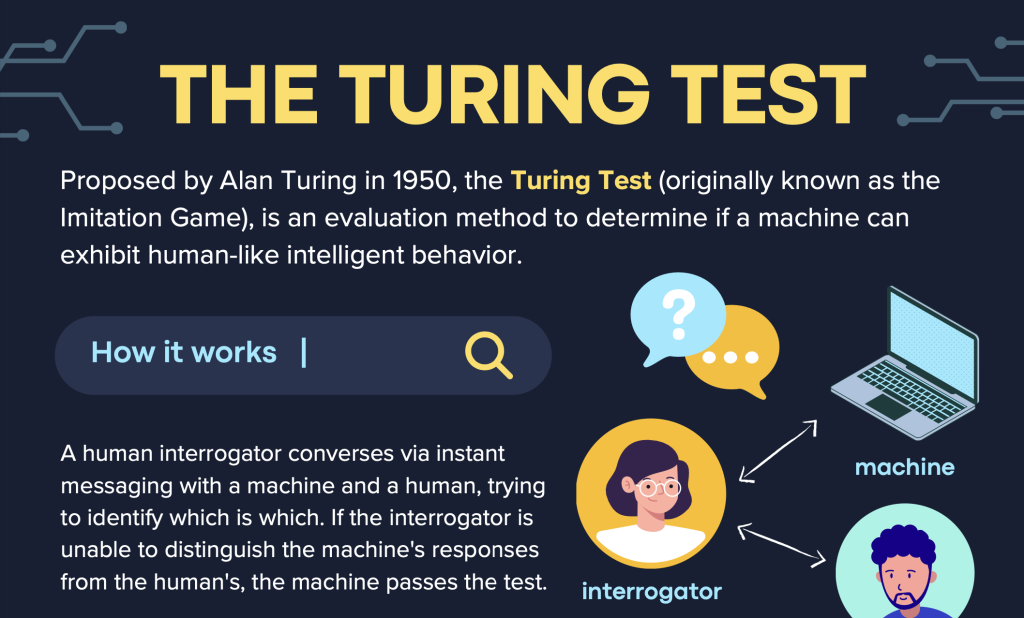
The typical setup of a Turing Test involves three key components: a human judge, a machine (often a computer program), and a human participant. The interactions between these parties are designed to assess the machine’s ability to mimic human responses convincingly.
Setup and Roles in the Turing Test
In a standard Turing Test, the setup usually consists of a controlled environment where the judge can interact with both the machine and the human participant. This interaction is typically conducted through a text-based interface, eliminating any biases related to appearance or voice. Here’s a breakdown of the roles involved in the test:
- Judge: The human judge is tasked with determining which participant — the machine or the human — is providing the responses. Their evaluations are based on the quality of the conversation and the coherence of responses.
- Machine: The machine, often an AI chatbot or program, is designed to generate responses that are as human-like as possible. Its objective is to deceive the judge into thinking it is the human participant.
- Human Participant: The human participant engages in conversation with the judge and the machine. Their responses serve as a benchmark against which the machine is measured.
The criteria for success in the Turing Test hinge on the judge’s inability to reliably distinguish between the machine and the human. If the judge cannot differentiate which participant is which more than 50% of the time, the machine is said to have passed the test. This outcome demonstrates that the machine can produce responses that are contextually appropriate and relevant, thus mimicking human-like understanding.
“The Turing Test is not a test of intelligence, but a test of behavior.”
By assessing the interactions, researchers gain insights into the capabilities of AI systems and their potential for advanced conversational abilities. The implications of passing the Turing Test extend beyond mere academic interest; they raise important questions about the nature of intelligence and the future of human-machine interaction.
The philosophical implications of the Turing Test on consciousness and intelligence
The Turing Test, proposed by Alan Turing in 1950, has sparked extensive debate about the nature of consciousness and intelligence, particularly in relation to machines. It raises critical questions about what it means to be intelligent and whether machines can truly replicate human-like understanding or awareness. As technology advances, these discussions become increasingly relevant, challenging our perceptions of both artificial intelligence and our own cognition.
Philosophical discussions surrounding the Turing Test often revolve around the distinction between simulating intelligence and possessing true consciousness. While a machine may pass the Turing Test by convincingly mimicking human responses, it does not necessarily imply that the machine has an understanding of those responses. This distinction leads to various viewpoints regarding machine intelligence. For example, John Searle’s “Chinese Room” argument posits that a person in a room following instructions to manipulate Chinese symbols does not understand the language, despite producing correct answers. This analogy suggests that machines may simulate understanding without genuine comprehension.
Arguments for and against machine intelligence
The debate on whether machines can possess intelligence encompasses numerous philosophical arguments, each contributing to a deeper understanding of consciousness.
Arguments supporting machine intelligence include:
-
Functionalism Theory:
This theory posits that mental states are defined by their function rather than their internal composition. If a machine can perform the functions of thought and reasoning, it could be considered intelligent.
-
Behavioral Evidence:
Proponents argue that if a machine can consistently demonstrate intelligent behavior indistinguishable from a human, it should be regarded as possessing intelligence, regardless of its internal processes.
Counterarguments against machine intelligence consist of:
-
Qualia and Subjective Experience:
Critics assert that machines lack qualitative experiences, or “qualia,” which are essential for true consciousness. This absence implies that machines cannot genuinely understand or experience emotions and thoughts.
-
Intentionality:
The ability to have intentions or beliefs is a fundamental aspect of human consciousness. Critics argue that machines, even if they simulate understanding, do not possess genuine intentionality, undermining their status as intelligent entities.
The Turing Test challenges our understanding of intelligence by suggesting that if a machine can successfully convince humans of its intelligence through dialogue, it may necessitate a reevaluation of our definitions of consciousness and cognitive abilities. This testing criterion implies that intelligence could be measured not just by reasoning or problem-solving capabilities, but by the ability to engage in human-like interactions. As artificial intelligence continues to evolve, the implications of the Turing Test will remain a pivotal issue in discussions about the nature of consciousness and the potential for machines to be deemed intelligent.
Criticism of the Turing Test and alternative approaches to evaluate machine intelligence
The Turing Test, introduced by Alan Turing in 1950, aims to assess a machine’s ability to exhibit intelligent behavior indistinguishable from that of a human. While it remains a pivotal reference in discussions about artificial intelligence, it has faced various criticisms that highlight its limitations as a definitive measure of machine intelligence. This assessment, based heavily on conversational interactions, raises questions about what it truly means to be “intelligent” and the broader implications for AI evaluation.
Critics argue that the Turing Test is an inadequate barometer of true understanding or consciousness. A machine might convincingly mimic human conversation without possessing genuine comprehension. This leads to the notion that passing the Turing Test does not necessarily indicate intelligence, but rather skill in deception. Furthermore, the test focuses solely on linguistic proficiency, neglecting other essential cognitive abilities such as reasoning, problem-solving, and emotional intelligence.
Limitations of the Turing Test
The Turing Test’s reliance on human-like responses and conversational skills leads to several notable limitations. The following points illustrate these constraints:
- Surface-Level Interaction: The test evaluates superficial conversation rather than deep understanding or reasoning.
- Deceptive Capability: A machine can be programmed to imitate human responses without real intelligence, showcasing only mimicry.
- Subjective Interpretation: The assessment can vary based on the evaluator’s expectations and biases, making it inconsistent.
- Neglect of Multi-faceted Intelligence: The Turing Test does not account for non-verbal intelligence or abilities outside of language.
Given these limitations, several alternative assessments have been proposed to evaluate machine intelligence more comprehensively.
Alternative Assessments of Machine Intelligence
Various alternative tests provide a broader range of criteria for evaluating machine intelligence. These alternatives strive to encompass deeper cognitive capabilities beyond mere conversation. A selection of notable alternatives includes:
- The Lovelace Test: This test requires a machine to create something original, such as an artwork or a piece of music, that cannot be predicted by its creators. It emphasizes creativity over mimicry.
- The Coffee Test: Proposed by Steve Wozniak, this test assesses whether a robot can enter an unfamiliar home, make coffee, and clean up afterward, demonstrating practical problem-solving skills.
- The Robot College Student Test: This assessment challenges a robot to learn and engage in a college course, showcasing its ability to assimilate knowledge and apply it effectively in a structured environment.
While these alternatives present innovative frameworks for evaluating machine intelligence, their practicality may vary. The Lovelace Test, for example, is subjective and may not yield easily quantifiable results, whereas the Coffee Test emphasizes practical skills that can be observed in real-world scenarios. Comparatively, the Turing Test remains more established and accessible, despite its limitations.
“The Turing Test assesses imitation, whereas alternative tests may evaluate understanding, creativity, and practical skills.”
In conclusion, the exploration of machine intelligence evaluations reveals that reliance on the Turing Test alone is insufficient. As artificial intelligence continues to evolve, adopting a multi-faceted approach to assessment will be crucial for truly understanding and harnessing the capabilities of intelligent machines.
Real-world applications of the Turing Test in technology and industry
The Turing Test has had a profound impact on various technological advancements, particularly in the realm of artificial intelligence. As AI has become more integrated into daily life, the Turing Test serves as a benchmark for assessing a machine’s ability to exhibit intelligent behavior indistinguishable from that of a human. This section highlights how this test has influenced the development of chatbots and virtual assistants, its application across different industries, and the implications of AI systems that pass the test.
Influence on Chatbots and Virtual Assistants
The Turing Test has played a crucial role in shaping the functionality and user interaction of chatbots and virtual assistants. These AI systems are designed to simulate human-like conversations, providing users with seamless interaction and support. Key examples of this influence include:
- OpenAI’s Kami: This model showcases advanced conversational abilities, capable of understanding context and providing informative responses, making it a leader in the chatbot domain.
- Apple’s Siri: Siri utilizes natural language processing to comprehend user requests, responding in a manner that mimics human dialogue and engagement.
- Amazon’s Alexa: Alexa incorporates Turing Test principles to deliver personalized experiences and execute commands through voice interactions, further enhancing user satisfaction.
These examples illustrate the importance of the Turing Test in ensuring that virtual assistants and chatbots can effectively communicate and provide valuable assistance, making them integral tools for businesses and consumers alike.
Application Across Industries
Various industries have adopted the Turing Test to evaluate and enhance their AI systems, ensuring they meet the necessary standards for human-like interaction. Notable sectors include:
- Customer Service: AI-driven chatbots are employed to manage customer inquiries efficiently, helping businesses reduce operational costs while maintaining high service levels.
- Healthcare: Virtual health assistants utilize Turing Test principles to offer patients personalized advice and support, improving patient engagement and satisfaction.
- Finance: Automated financial advisors employ AI to interact with clients, providing investment insights and personalized financial planning.
The implementation of AI evaluated through the Turing Test enhances service delivery, ensuring that clients receive human-like interactions that improve overall satisfaction and trust in the technology.
Implications of Passing the Turing Test
The ability of an AI system to pass the Turing Test carries significant implications for its deployment in real-world scenarios. Notable consequences include:
- Customer Service Efficiency: Passing the Turing Test allows chatbots to handle complex customer service interactions, leading to faster response times and elevated customer satisfaction.
- Enhanced Patient Care: In healthcare, AI systems that pass the Turing Test can offer empathetic and personalized support, addressing patient concerns more effectively and leading to better health outcomes.
- Increased Trust in AI: When AI demonstrates human-like understanding and responses, users are more likely to trust and engage with these systems, leading to broader acceptance of AI technologies across various fields.
The implications of passing the Turing Test underline the potential for AI to transform industries by offering more efficient, reliable, and engaging systems that align closely with human behavior and expectations.
Future directions for the Turing Test in the evolving landscape of AI
The Turing Test, designed to evaluate a machine’s ability to exhibit intelligent behavior indistinguishable from that of a human, faces an evolving landscape as AI technology advances. As machine learning and natural language processing develop, the relevance and application of the Turing Test may require rethinking to ensure it remains a valid measure of machine intelligence. This shift prompts a discussion on potential new methodologies and the evolution of the Turing concept itself in the face of sophisticated AI systems.
Changes in Relevance Due to AI Advancements
The rapid advancement of AI technologies raises questions about the continued applicability of the Turing Test. Traditional implementations often focus on linguistic capabilities and conversational nuances. However, as AI systems become more adept at mimicking human-like responses, they may also surpass the criteria set by the Turing Test without necessarily demonstrating true understanding or consciousness.
For instance, recent developments in generative models, like OpenAI’s Kami, illustrate how machines can produce coherent and contextually relevant text that could easily deceive a human evaluator. This trend indicates a need for more nuanced evaluation methods that consider:
- Contextual Awareness: Understanding and processing context beyond mere conversation.
- Emotional Intelligence: Recognizing and responding to human emotions appropriately.
- Problem Solving: Demonstrating reasoning abilities and innovative solutions.
New Methodologies for Evaluating Machine Intelligence
As AI technology progresses, the methodologies used to assess machine intelligence are likely to evolve. Future evaluations may integrate more comprehensive criteria beyond conversation, incorporating elements such as cognitive functions, adaptive learning, and ethical decision-making.
To reflect the growing capabilities of AI systems, potential methodologies might include:
- Behavioral Assessment: Evaluating AI through tasks that require reasoning, creativity, and adaptability rather than simple conversation.
- Multi-Faceted Interaction: Engaging AI in various contexts—social, emotional, and technical—to gauge its versatility and depth of understanding.
- Ethical Reasoning Tests: Assessing how AI systems make choices in morally ambiguous situations, reflecting real-world complexities.
Evolution of the Turing Test Concept
The concept of the Turing Test is likely to evolve as technology advances. Emerging AI systems may challenge traditional notions of intelligence, prompting the development of new standards and benchmarks. This evolution could lead to the formulation of more rigorous tests that evaluate a machine’s cognitive capabilities rather than merely its ability to engage in conversation.
“The future of AI evaluation lies not just in mimicking human intelligence but in refining and expanding our understanding of what intelligence truly encompasses.”
As AI matures, we may witness a shift towards holistic assessments that balance linguistic aptitude with problem-solving skills, emotional intelligence, and ethical reasoning. Such a comprehensive approach would contribute to a deeper understanding of machine capabilities and foster responsible advancements in AI technology.
End of Discussion
In summary, the Turing Test remains a critical touchstone in the understanding of artificial intelligence, sparking ongoing discussions about the nature of intelligence itself. As technology advances, the implications of this test may shift, challenging us to redefine our expectations and understanding of both machines and human cognition.
Clarifying Questions
What is the main purpose of the Turing Test?
The main purpose of the Turing Test is to assess a machine’s ability to exhibit intelligent behavior equivalent to, or indistinguishable from, that of a human.
Can a machine truly be intelligent?
This is a debated topic; some argue that intelligence is a human characteristic, while others believe machines can demonstrate forms of intelligence through their programmed responses.
Has any machine ever officially passed the Turing Test?
While some claims exist, there is no universally accepted instance of a machine passing the Turing Test, as conditions and interpretations vary widely.
Why is the Turing Test criticized?
The Turing Test is criticized for oversimplifying human intelligence and consciousness, as it focuses solely on conversational ability rather than deeper cognitive functions.
What are some alternatives to the Turing Test?
Alternatives include the Lovelace Test, which evaluates creativity, and the Coffee Test, assessing a machine’s ability to perform tasks in a human-like manner.