Semiconductors play a pivotal role in our daily lives, often going unnoticed yet fundamentally enabling the technology we rely on. From smartphones that connect us with the world to computers that power our work and home appliances that simplify our routines, semiconductors are at the heart of it all, making complex functionalities possible. These materials are not just components but the backbone of our technological advancements, highlighting their significance in various sectors.
Their unique properties, such as electrical conductivity that can be manipulated, allow semiconductors to serve as the building blocks for integrated circuits, which are vital in modern electronics. The manufacturing process, while intricate, ensures that these materials are produced with precision and care, emphasizing the cleanroom environments necessary for creating high-quality semiconductor devices. This overview sets the stage for understanding not only the essentials of semiconductors but also their far-reaching impact on global technology trends.
The fundamental role of semiconductors in modern electronics

In today’s tech-driven world, semiconductors are at the heart of virtually all electronic devices, serving as the foundation for modern electronics. These materials have revolutionized the way we interact with technology, enabling the small, powerful, and efficient devices we rely on daily. From smartphones to computers and home appliances, semiconductors play a crucial role in enhancing functionality, performance, and user experience.
Semiconductors are materials that have electrical conductivity between that of a conductor and an insulator. Their unique properties allow them to be precisely engineered to control electrical currents. This capability is fundamental for the operation of electronic devices, where they enable functions such as data processing, signal amplification, and energy conversion. The development of integrated circuits, which are essentially small chips made up of numerous transistors (the building blocks of semiconductors), has paved the way for the compact design and high efficiency of modern electronics. For instance, smartphones rely on semiconductors for various functionalities including processing power, memory storage, and wireless communication. The processors in these devices, made from silicon—a common semiconductor material—are capable of performing billions of calculations per second, making them essential for tasks such as gaming, streaming, and multitasking.
Key semiconductor materials and their properties
Several key semiconductor materials are commonly used in the electronics industry, each with distinct properties that make them suitable for specific applications. Understanding these materials is essential as they dictate the performance and efficiency of electronic devices.
Silicon is the most widely used semiconductor, known for its excellent thermal stability and abundance. It is used in a vast array of devices, including microprocessors, solar cells, and integrated circuits. Another significant material is gallium arsenide (GaAs), which offers higher electron mobility than silicon, making it ideal for high-frequency applications such as RF and microwave devices.
Germanium, another semiconductor, was one of the first materials used in transistors. It has higher intrinsic carrier mobility but is less stable than silicon under high-temperature conditions. Indium phosphide (InP) is also noteworthy for its application in optoelectronics and high-speed devices due to its direct bandgap, which allows for effective photon emission and absorption.
In summary, semiconductors like silicon, gallium arsenide, and germanium are crucial in powering the technologies that shape our everyday lives. Their unique properties and potential for miniaturization and efficiency continue to drive innovation in the electronics industry, contributing to the ever-advancing landscape of modern technology.
The manufacturing process of semiconductor devices
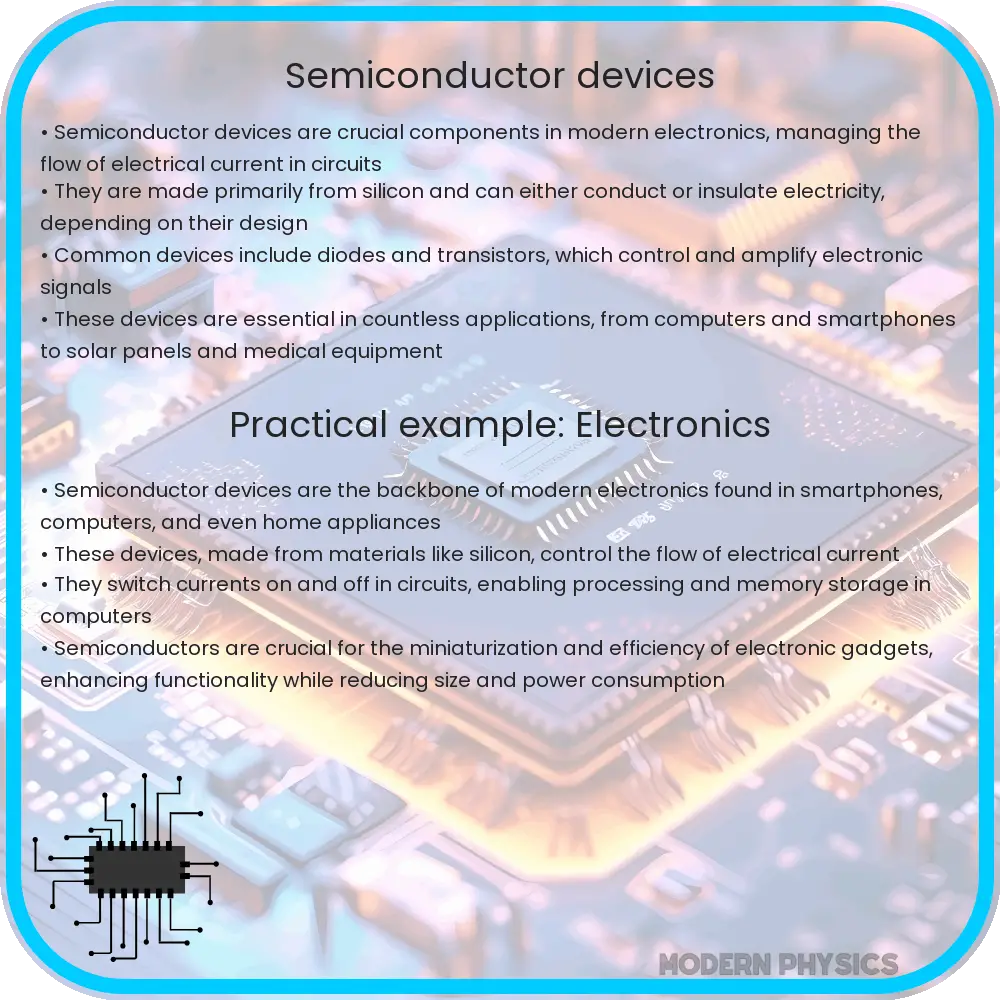
The manufacturing process of semiconductor devices is a complex and highly controlled procedure that transforms raw materials into functional electronic components. This process involves a series of intricate steps that must be precisely executed to ensure the reliability and efficiency of the final product. Understanding these steps is essential for grasping how semiconductors are made and the technologies that drive modern electronics.
Step-by-step fabrication process
The fabrication of semiconductor devices is accomplished through several key stages, each contributing to the overall creation of integrated circuits. Here is a detailed breakdown of the semiconductor fabrication process:
1. Wafer Preparation: The process begins with the selection of high-purity silicon, which is melted and crystallized into a cylindrical ingot. This ingot is then sliced into thin discs, called wafers, which serve as the substrate for the semiconductor devices.
2. Oxidation: A thin layer of silicon dioxide is grown on the surface of the wafer through thermal oxidation. This layer acts as an insulator and protects the silicon from contamination.
3. Photolithography: This step uses a light-sensitive photoresist material to create patterns on the wafer. A mask, which contains the desired circuit design, is placed over the wafer, and ultraviolet light is used to expose the photoresist.
4. Etching: After developing the photoresist, the exposed areas of the silicon dioxide layer are etched away using chemical or plasma etching techniques. This step transfers the pattern from the mask onto the wafer.
5. Doping: To modify the electrical properties of the silicon, doping introduces impurities into specific areas of the wafer using processes like ion implantation. This creates p-type or n-type regions, which are essential for forming transistors.
6. Metallization: Thin metal layers, often made of aluminum or copper, are deposited onto the wafer to create electrical connections between different components. This is typically achieved through sputtering or evaporation techniques.
7. Packaging: Once the wafers are fully processed, they are cut into individual chips, known as die. These chips are then packaged to protect them from environmental damage and to facilitate integration into electronic devices.
Each of these steps requires meticulous precision and control to ensure that the final semiconductor devices meet stringent performance and reliability standards.
Cleanroom environments in semiconductor manufacturing
The significance of cleanroom environments in semiconductor manufacturing cannot be overstated. Cleanrooms are specially designed spaces that maintain controlled levels of contamination, temperature, humidity, and pressure. The presence of microscopic particles can severely affect the quality and performance of semiconductor devices. Here are key aspects of cleanrooms:
– Particle Control: Cleanrooms utilize high-efficiency particulate air (HEPA) filters to remove airborne contaminants. The cleanliness of a cleanroom is rated based on the number of allowable particles per cubic meter of air.
– Temperature and Humidity Regulation: Maintaining stable temperature and humidity levels is crucial as fluctuations can impact the chemical reactions and material properties during fabrication.
– Gowning Procedures: Personnel entering cleanrooms must adhere to strict gowning protocols, including wearing special suits, gloves, and masks, to minimize the risk of introducing contaminants.
The controlled environment of cleanrooms ensures that semiconductor manufacturing processes can happen without interference from external contaminants, leading to higher yields and better-quality products.
Equipment used in semiconductor production
The production of semiconductors relies on advanced equipment that supports each stage of fabrication. Innovative technologies continually enhance this equipment’s capabilities, leading to greater efficiency and precision. Key tools include:
– Photolithography Equipment: This includes step-and-repeat lithography machines that project intricate patterns onto the wafer surface. Advanced tools use extreme ultraviolet (EUV) lithography, allowing for smaller feature sizes and increased circuit density.
– Etching Systems: Both wet and dry etching systems are used, with reactive ion etching (RIE) offering high precision in patterning. Recent innovations include atomic layer etching (ALE), which provides even finer control over layer thickness.
– Deposition Tools: Chemical vapor deposition (CVD) and physical vapor deposition (PVD) systems are essential for depositing thin films of materials onto wafers. Atomic layer deposition (ALD) is a cutting-edge technique for producing ultra-thin films with atomic-level precision.
– Doping Machines: Ion implanters are sophisticated devices that precisely introduce dopants into the silicon wafer. Continuous advancements in these machines have led to increased implantation accuracy and efficiency.
These tools collectively enable semiconductor manufacturers to produce complex integrated circuits that power modern electronics, from smartphones to high-performance computing systems.
Different types of semiconductor materials and their applications
Semiconductor materials play a pivotal role in modern electronics, providing the foundation for various devices and technologies. Their unique electrical properties allow for the control of electrical current, making them essential in a multitude of applications across diverse industries. This section highlights three prominent types of semiconductor materials, their applications, and a comparative analysis of their performance characteristics.
Silicon-based Semiconductors
Silicon is the most widely used semiconductor material due to its abundance and favorable electrical properties. It is primarily utilized in the production of integrated circuits, transistors, and solar cells. Silicon’s energy bandgap of 1.1 eV makes it ideal for applications in electronic devices, enabling efficient energy conversion and signal processing.
- Consumer Electronics: Silicon semiconductors are the backbone of devices such as smartphones, laptops, and tablets, facilitating high-speed processing and data storage.
- Automotive Industry: In electric vehicles, silicon is used in power electronics for battery management systems and motor control, enhancing energy efficiency and performance.
- Renewable Energy: Solar panels utilizing silicon-based cells convert sunlight into electricity, contributing to the push for sustainable energy solutions.
Gallium Arsenide (GaAs) Semiconductors
Gallium arsenide is another crucial semiconductor material known for its superior electron mobility and efficiency in converting electricity into light. With a direct bandgap of 1.42 eV, GaAs is particularly advantageous for optoelectronic applications, such as LEDs and laser diodes.
- Telecommunications: GaAs is widely used in high-frequency applications, including satellite communications and mobile phone technologies, providing improved signal quality and faster data transmission.
- Optoelectronics: Devices such as fiber optic transceivers and infrared LEDs leverage GaAs for superior performance, essential in modern communication systems.
- Solar Cells: GaAs solar cells are notably efficient, with conversion efficiencies exceeding 30%, making them suitable for space applications where weight and efficiency are critical.
Silicon Carbide (SiC) Semiconductors
Silicon carbide is gaining traction as a high-performance semiconductor material, particularly in high-temperature and high-voltage environments. With a wide bandgap of approximately 3.3 eV, SiC devices can operate at elevated temperatures, making them ideal for demanding applications.
- Power Electronics: SiC is extensively used in power converters and inverters for renewable energy systems, enhancing efficiency and reducing energy losses.
- Automotive Applications: In electric and hybrid vehicles, SiC technology is implemented for onboard chargers and power management systems, enabling faster charging and improved performance.
- Industrial Applications: SiC is utilized in high-temperature environments, such as manufacturing processes and semiconductor fabrication, where traditional materials may fail.
Comparative analysis of these semiconductor materials reveals distinct performance characteristics. Silicon remains the dominant material for most electronic devices due to its cost-effectiveness and versatility. In contrast, GaAs excels in high-frequency and optoelectronic applications, while SiC is favored in scenarios requiring high thermal and voltage tolerance. Understanding these differences allows industries to select the most suitable semiconductor material for specific applications, driving innovation and efficiency across technology sectors.
The impact of semiconductors on global technology trends
The evolution of semiconductor technology plays a crucial role in shaping the landscape of modern technological advancements. As the backbone of many digital devices, semiconductors are not just about powering electronics; they are driving significant trends such as artificial intelligence (AI), the Internet of Things (IoT), and the rollout of 5G networks. This connection between semiconductor advancements and broader technology trends illustrates their fundamental importance in today’s digital age.
Influence of semiconductor advancements on AI and IoT
The relationship between semiconductor innovations and the growth of AI and IoT is evident in the performance and efficiency improvements of chips that cater specifically to these technologies. Modern AI applications require immense computational power to process large datasets and perform complex algorithms. Semiconductors have evolved to meet these requirements through specialized architectures like Graphics Processing Units (GPUs) and Tensor Processing Units (TPUs).
In the realm of IoT, semiconductors enable connectivity and data processing capabilities within smart devices. The miniaturization of chips has allowed for more efficient and smaller devices that can communicate and analyze data in real-time. This has led to a surge in smart home devices, wearables, and industrial IoT applications. The following points underscore the impact of semiconductors on AI and IoT:
- Advanced chip designs enhance machine learning algorithms, allowing for faster and more efficient data processing.
- Low-power semiconductors are essential for battery-operated IoT devices, promoting longer usage and sustainability.
- Edge computing is facilitated by semiconductors, enabling data processing at the source rather than relying solely on cloud computing.
Relationship between semiconductor innovation and 5G technology
The rollout of 5G technology heavily relies on advancements in semiconductor technology. 5G networks promise higher speeds, lower latency, and the ability to connect a vast number of devices simultaneously. Semiconductors play a pivotal role in this evolution by providing the necessary processing power and efficiency to handle the increased data traffic and connectivity needs of 5G.
Key aspects demonstrating the link between semiconductor innovation and 5G development include:
- New materials and manufacturing techniques, such as Gallium Nitride (GaN), improve the efficiency and performance of 5G base stations.
- Semiconductors designed for millimeter-wave technology enable faster data transmission rates in 5G networks.
- Advancements in radio frequency (RF) components and integrated circuits are crucial for the deployment of 5G infrastructure.
Future trends in semiconductor applications across different sectors
Looking ahead, several trends indicate how semiconductors will continue to impact various sectors. Industries are increasingly recognizing the potential of semiconductor applications beyond traditional electronics. As technologies evolve, sectors like automotive, healthcare, and renewable energy are set to benefit significantly.
Key predictions include:
- The automotive industry is shifting towards electric and autonomous vehicles, driving demand for advanced semiconductors that manage power and facilitate communication.
- Healthcare will leverage semiconductor technology for wearable health monitoring devices and telemedicine applications, enhancing patient care and real-time data analysis.
- Renewable energy solutions will utilize semiconductors for smart grid technologies, improving energy efficiency and distribution.
“The future of technology is intricately linked with the ongoing advancements in semiconductor innovation, paving the way for smarter, more connected ecosystems.”
Challenges faced by the semiconductor industry today
The semiconductor industry is currently navigating a landscape filled with significant challenges that impact production, innovation, and market dynamics. Key issues such as supply chain disruptions and geopolitical tensions have arisen, complicating operations and stifling growth. Understanding these hurdles is crucial for stakeholders who wish to adapt and thrive in this ever-evolving sector.
The ongoing global semiconductor shortage has been exacerbated by various supply chain issues, including raw material shortages and logistical bottlenecks. Geopolitical factors, such as trade tensions between the United States and China, further complicate the scenario, leading to uncertainty in production capacity and market stability. These challenges not only impact manufacturing but also hinder innovation as companies struggle to allocate resources effectively.
Supply Chain Issues
The semiconductor supply chain is intricate and often vulnerable to disruptions. These disruptions have led to a ripple effect across multiple industries that rely heavily on semiconductor components. The importance of addressing these issues cannot be overstated, as they significantly affect the ability to meet market demand.
- Material Shortages: Essential materials like silicon and rare earth elements are experiencing shortages, primarily due to increased global demand and limited mining capacities.
- Logistical Bottlenecks: The pandemic has highlighted the fragility of global supply chains, with shipping delays and container shortages creating backlogs in production timelines.
- Manufacturing Capacity: Existing fabs are operating at full capacity, making it challenging to scale up production to meet rising demand.
Geopolitical Factors
Geopolitical factors play a significant role in shaping the semiconductor landscape, leading to uncertainties in production and trade. These tensions can also influence market competition, potentially leading to a fragmented industry.
- Trade Restrictions: Tariffs and export controls can limit the flow of semiconductor products between nations, affecting pricing and availability.
- National Security Concerns: Governments are increasingly prioritizing domestic semiconductor production to reduce reliance on foreign entities, leading to significant investments in local fabs.
- Collaborations and Alliances: Countries are forming strategic partnerships to bolster their semiconductor capabilities and mitigate risks associated with geopolitical tensions.
Strategic Responses by Companies
In response to these challenges, companies in the semiconductor industry are adopting various strategies to enhance resilience and maintain competitive advantages. Strategic partnerships and technological advancements are at the forefront of these efforts.
- Joint Ventures: Companies like Intel and TSMC are collaborating to establish advanced manufacturing facilities aimed at increasing production capacity and improving supply chain robustness.
- Investment in R&D: Firms are directing significant resources towards research and development to innovate new semiconductor materials and processes, which can help alleviate existing supply constraints.
- Diversifying Supply Chains: Manufacturers are increasingly looking to diversify their supply sources to reduce dependency on single countries or suppliers, thereby enhancing supply chain stability.
Future prospects of semiconductor technologies
As we look forward, the future of semiconductor technologies is set to be defined by remarkable advancements that are likely to transform numerous industries. With the continuous drive for enhanced performance and efficiency, emerging technologies such as quantum computing will increasingly depend on semiconductor innovations. This synergy between quantum computing and semiconductor advancements offers exciting opportunities for research and development, ensuring that the field remains at the forefront of technological evolution.
Emerging Technologies and Quantum Computing
Quantum computing stands out as a revolutionary technological frontier, with semiconductors serving as the backbone of this advancement. Quantum computers leverage qubits for processing, and harnessing the power of semiconductors is crucial for the development of stable and reliable qubits. The integration of semiconductor materials with quantum architectures will pave the way for more efficient quantum gates and error correction methods.
The relationship between quantum computing and semiconductor technologies can be summarized as follows:
- Semiconductors enhance qubit performance, enabling better coherence times and lower error rates.
- Innovative semiconductor fabrication techniques allow for the miniaturization of quantum circuits, making them more accessible for commercial applications.
- Research in semiconductor materials, such as topological insulators and superconductors, is critical for creating new quantum devices.
Potential Breakthroughs in Semiconductor Research
The semiconductor industry is on the brink of several significant breakthroughs that could impact various fields, including healthcare, telecommunications, and artificial intelligence. Advancements in materials science, such as the development of two-dimensional materials like graphene and transition metal dichalcogenides, could lead to enhanced semiconductor performance.
The possible implications of these breakthroughs are profound:
- In healthcare, new semiconductor devices could lead to more accurate diagnostic tools and advanced imaging technologies.
- Telecommunications might experience unprecedented speed and capacity improvements through the integration of advanced semiconductor technologies in 5G and beyond.
- In artificial intelligence, faster processors with lower power consumption will enable the deployment of complex algorithms in real-time, enhancing machine learning applications.
Evolution of the Semiconductor Landscape Over the Next Decade
As we approach the next decade, the semiconductor landscape is expected to undergo significant transformations influenced by emerging technologies and market demands. The drive for sustainability and energy efficiency will push manufacturers to explore new materials and processes, such as biocompatible semiconductors and eco-friendly production techniques.
Key trends likely to shape the industry include:
“The semiconductor industry will increasingly prioritize sustainability without compromising performance.”
- The rise of edge computing will necessitate the development of specialized semiconductors optimized for distributed computing environments.
- Integration of artificial intelligence in semiconductor design will lead to smarter chips capable of self-optimization.
- Collaboration between tech companies and research institutions will accelerate innovation cycles, resulting in quicker deployment of cutting-edge technologies.
The role of government policies in the semiconductor industry
Government policies play a pivotal role in shaping the landscape of the semiconductor industry. They influence everything from manufacturing processes to research and development initiatives. As a critical sector for technological advancement and economic growth, the semiconductor industry relies heavily on supportive policies that stimulate innovation and enhance competitiveness.
Government regulations and policies impact semiconductor manufacturing and innovation by establishing frameworks that either encourage or hinder investments. For instance, regulatory standards concerning environmental sustainability and labor practices can dictate operational costs and influence company decisions on manufacturing locations. These regulations can lead to increased costs, but they can also encourage companies to innovate in order to meet these standards efficiently.
Government funding for semiconductor research and development
Government funding for semiconductor research and development is essential to maintain the competitive edge of nations in the global market. This funding supports initiatives that promote innovation in chip design, manufacturing techniques, and materials science. It often provides the necessary capital for startups and established companies alike to explore new avenues of technology.
Significant examples of government funding include:
- The CHIPS Act in the United States, which allocates billions to incentivize domestic semiconductor manufacturing and R&D.
- The European Union’s Digital Compass initiative aims to bolster the region’s semiconductor sector by increasing investments and fostering collaboration among member states.
- China’s National Integrated Circuit Industry Investment Fund (also known as the “Big Fund”) has poured substantial resources into developing a self-sufficient semiconductor industry.
Through these funding mechanisms, governments aim to reduce reliance on foreign technologies and strengthen national security.
International policies influencing the global semiconductor market
International policies significantly shape the dynamics of the global semiconductor market, affecting trade relations, supply chains, and competitive positioning. Policies such as tariffs and trade agreements can either facilitate or obstruct the flow of semiconductor products across borders.
Key influences include:
- Trade agreements like the USMCA, which impact semiconductor companies operating in North America by setting rules on intellectual property and technology transfers.
- Export controls imposed by the U.S. government on semiconductor technology to certain countries, aimed at protecting national security interests while reshaping global supply chains.
- The EU’s approach to fostering a competitive semiconductor ecosystem, emphasizing collaboration with non-EU nations while simultaneously protecting intellectual property rights and technological advancements.
These policies not only affect the cost structures and operational efficiencies of semiconductor firms but also determine the competitive landscape globally.
“Government involvement in the semiconductor industry is crucial for fostering innovation and maintaining technological leadership.”
The significance of sustainability in semiconductor production
The semiconductor industry plays a crucial role in the technological advancements of our time, but its manufacturing processes significantly impact the environment. As the demand for electronic devices continues to rise, so does the urgency for sustainable practices within this sector. Addressing environmental concerns is critical not only for regulatory compliance but also for the industry’s long-term viability and reputation.
The production of semiconductors involves multiple processes that can have detrimental effects on the environment. These processes often utilize hazardous materials, require considerable energy, and generate substantial waste. The extraction of raw materials, such as silicon and rare earth metals, contributes to habitat destruction and pollution. Moreover, the manufacturing processes generate greenhouse gases and other emissions, further exacerbating climate change.
Environmental impacts of semiconductor manufacturing processes and materials
The environmental footprint of semiconductor manufacturing is extensive, encompassing several key areas:
- Resource Depletion: Mining for silicon and rare earth elements leads to significant land degradation and loss of biodiversity.
- Energy Consumption: The production stages of semiconductors are energy-intensive, often relying on fossil fuels, which contribute to carbon emissions.
- Chemical Waste: The use of toxic chemicals in cleaning and etching processes poses risks to water systems and air quality, necessitating stringent waste management protocols.
- Water Usage: Semiconductor fabrication plants consume large volumes of water, raising concerns about water scarcity in some regions.
- Greenhouse Gas Emissions: Emissions from manufacturing processes significantly contribute to global warming, necessitating immediate action.
The semiconductor industry is increasingly recognizing the need for sustainable practices to mitigate these environmental impacts.
Initiatives to promote sustainable practices within the semiconductor industry
To address these challenges, various initiatives are being implemented across the semiconductor sector, including:
- Renewable Energy Adoption: Many companies are transitioning to renewable energy sources, such as solar and wind power, to reduce their carbon footprint.
- Circular Economy Practices: Firms are adopting circular economy principles, focusing on recycling materials and improving product life cycles to minimize waste.
- Green Chemistry: The industry is exploring alternative materials and processes that reduce or eliminate the use of hazardous substances.
- Water Conservation Techniques: Technologies are being developed to recycle water used in manufacturing processes, significantly lowering overall consumption.
- Industry Collaborations: Partnerships between companies, governments, and non-profits are fostering innovation in sustainable practices and setting higher industry standards.
These initiatives are not just regulatory responses; they also align with the growing consumer demand for environmentally responsible products.
The future of green technologies in semiconductor production
The future of semiconductor manufacturing is likely to be shaped by ongoing advancements in green technologies. As companies strive for sustainability, several trends are emerging:
- Advanced Materials: Research is focused on developing new materials that offer better performance with lower environmental impacts, such as biodegradable polymers.
- Smart Manufacturing: The integration of AI and IoT in manufacturing processes is optimizing resource use, reducing waste, and improving energy efficiency.
- Life Cycle Assessment: Companies are increasingly adopting life cycle assessment tools to evaluate the environmental impacts of their products from production to disposal.
- Investment in R&D: Significant investments in research and development are expected to yield innovative solutions that enhance sustainability in production.
- Regulatory Support: Governments are likely to impose stricter environmental regulations, pushing the industry toward greener practices.
“Investing in sustainable semiconductor production is not just an ethical choice; it is a strategic imperative for future growth and innovation.”
Through these advancements, the semiconductor industry can transform its environmental impact, paving the way for a more sustainable future while maintaining its pivotal role in the global economy.
Wrap-Up
In conclusion, semiconductors are more than just materials; they are catalysts for innovation, shaping the future of technology across various industries. As we face challenges like supply chain issues and strive for sustainable practices, the semiconductor industry continues to evolve and adapt. Looking ahead, we can expect groundbreaking advancements that will further integrate semiconductors into emerging technologies, ensuring their continued relevance and importance in our ever-connected world.
FAQ Overview
What are semiconductors used for?
Semiconductors are used in a wide range of devices, including computers, smartphones, televisions, and various home appliances, enabling their electronic functionalities.
How are semiconductors different from conductors and insulators?
Unlike conductors, which allow electricity to flow freely, and insulators, which block it, semiconductors have properties that can be modified to conduct electricity under certain conditions.
What is the significance of cleanroom environments in semiconductor production?
Cleanroom environments prevent contamination during semiconductor manufacturing, ensuring high purity levels and quality in the final products.
How do government policies affect the semiconductor industry?
Government policies can influence semiconductor manufacturing through regulations, funding for research, and international trade agreements that impact market dynamics.
What are the future trends in semiconductor technology?
Future trends include advancements in quantum computing, AI integration, and the drive towards more sustainable manufacturing practices within the semiconductor industry.